

 11/08/2026
  9 mins to read
 Written by Richard Bourne 11th August 2026
Manufacturing and engineering businesses across the UK are competing for the same thing: fully skilled, experienced people who can step into a role and contribute immediately.
Whether a company needs welders, fabricators, maintenance engineers, CNC machinists, mechanical fitters or vehicle builders, the ideal candidate is often someone with years of directly relevant experience who already understands the machinery, materials and processes involved.
The difficulty is that only a limited number of these people are available within any local area. When several employers are searching for the same skills, relying entirely on external recruitment becomes increasingly challenging.
Recruitment will always be important, but future-proofing a manufacturing business must also begin with developing the people already on the shop floor.
The shortage of ready-made skills
Every employer would prefer to recruit someone who can start with minimal training. However, the number of fully skilled workers in a commutable area is limited.
Experienced candidates are often already employed, well paid and settled in their current positions. Those who are open to moving may receive several offers, giving them greater choice over pay, hours, shifts and location.
This creates a highly competitive market. Increasing salaries may help attract talent, but it does not increase the overall number of skilled people available.
Businesses that only search for exact match candidates can therefore leave important positions unfilled for months. During that time, existing employees may be working overtime, production can fall behind and experienced team members can face additional pressure.
A more sustainable approach combines external recruitment with structured in-house training and development.
Future-proofing starts from within
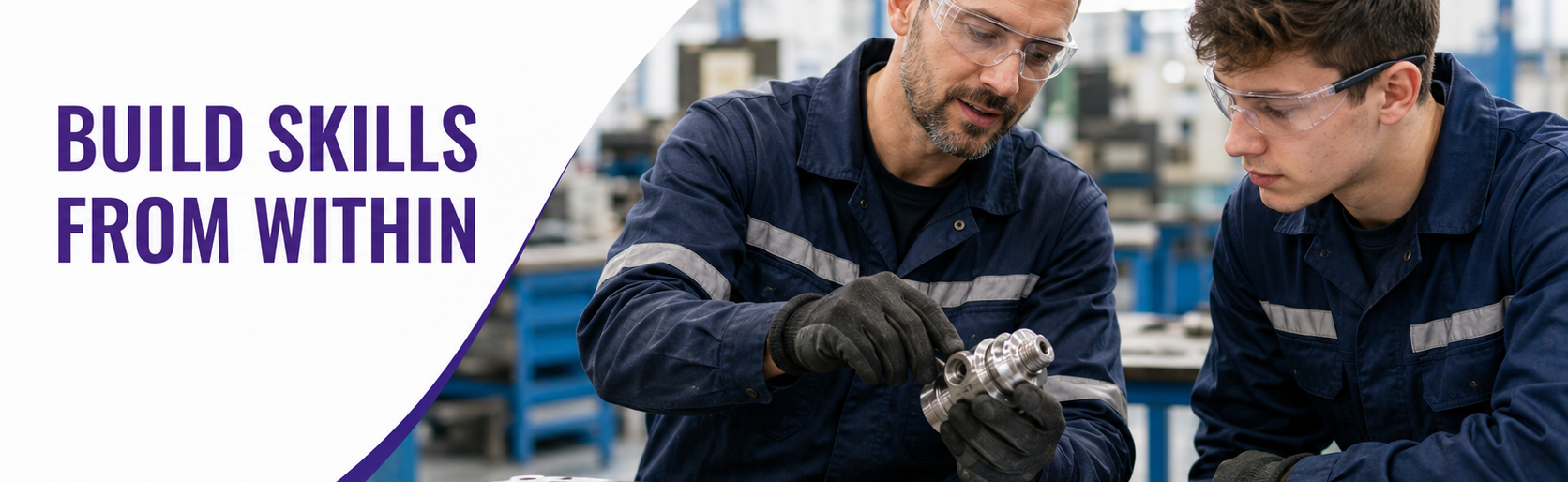
Upskilling existing and newly recruited employees allows a business to build the exact capabilities it needs.
Every manufacturing company has its own equipment, products, procedures and quality standards. Even a highly experienced new employee will normally require some training to understand how that particular business operates.
This raises an important question: if some training is already necessary, could a candidate with strong base skills and the right attitude be developed into the role?
A production operative who can read a tape measure, use hand tools and follow technical instructions may be capable of progressing into mechanical assembly. An experienced MIG welder could learn fabrication, marking out and drawing interpretation. A machine operator could be trained in setting, basic maintenance or quality inspection.
These employees may not arrive with every skill required, but they provide a strong foundation on which to build.
Training new employees for long-term success
Training should not simply consist of placing a new starter alongside an experienced employee and expecting them to learn everything immediately.
A structured approach produces better results and helps new employees understand what is expected of them.
A practical training plan might include:
- A clear induction covering safety, quality and production standards
- An introduction to the company’s products and manufacturing processes
- Training on tools, equipment and machinery
- Shadowing an experienced employee
- Starting with straightforward tasks before progressing to complex work
- Regular reviews to identify progress and further training needs
- Written training records or skills matrices
- Clear opportunities for progression
Breaking a role down into individual skills makes development easier to manage. It also allows supervisors to see exactly what a new employee can complete independently and where further support is required.
Not every employee will progress at the same speed, but providing clear stages and realistic goals creates a more consistent route towards competence.
Building a multi-skilled shop floor
A multi-skilled workforce gives manufacturers greater flexibility.
In many businesses, important knowledge sits with only one or two experienced employees. When those people are absent, leave the company or retire, the business can suddenly lose skills that have taken years to develop.
Cross-training reduces this risk by ensuring that more than one person understands each important process.
For example, a multi-skilled employee might be able to:
- Work across more than one assembly area
- Operate several machines
- Complete basic machine setting or tool changes
- Carry out quality inspections
- Read engineering drawings
- Measure and mark out materials
- Support basic maintenance or fault-finding
- Train less experienced colleagues
- Move between production areas when demand changes
This does not mean every employee must become an expert in every discipline. The aim is to develop useful flexibility while maintaining safe working practices and high-quality standards.
A well-maintained skills matrix can help managers identify existing strengths, training gaps and areas where the business depends too heavily on one individual.
Look beyond the exact job title
When recruiting new staff, employers should consider the candidate’s underlying abilities rather than relying only on previous job titles.
Job titles vary considerably between manufacturing businesses. Someone described as a production operative in one company may regularly use power tools, interpret drawings and assemble complex products. Another candidate with the title of assembler may have completed only one repetitive task.
A detailed assessment of practical experience can reveal transferable skills that are not immediately obvious from a CV.
Valuable starting skills include:
- Accurate use of a tape measure
- Experience using hand and power tools
- Measuring and marking out
- Basic drawing interpretation
- Mechanical aptitude
- Experience assembling components
- Understanding of factory safety
- Following production and quality instructions
- Reliability and consistent attendance
- A willingness to learn new processes
These foundations can often be developed into more specialist capabilities through workplace training.
Practical examples of progression
There are many realistic routes for developing people within manufacturing and engineering environments.
A general production operative with good practical ability could learn drilling, fastening and mechanical assembly before progressing into vehicle or trailer building.
A MIG welder could develop fabrication skills by learning to work from drawings, mark out steel, prepare joints and inspect finished components.
An experienced machine operator could be trained to complete changeovers, adjust settings and recognise common production faults.
A mechanical fitter could receive additional training in hydraulics, pneumatics or basic electrical systems, gradually developing into a more versatile maintenance technician.
A warehouse operative familiar with manufacturing materials and components could move into kitting, production control or a shop-floor assembly position.
These development routes create skilled employees while also offering people genuine career progression.
Retaining knowledge before it is lost
Many manufacturing businesses have highly experienced employees approaching retirement. Their knowledge may include techniques, settings and solutions that have never been formally recorded.
Waiting until someone leaves before addressing this gap creates unnecessary risk.
Experienced employees can play an important role in developing the next generation through mentoring, job shadowing and practical demonstrations. Processes can also be documented so that essential knowledge remains within the business.
Succession planning should not be limited to management positions. It is equally important for skilled shop-floor roles, machine setters, fabricators, maintenance engineers and team leaders.
Training someone before the skill is urgently needed is far more effective than attempting to replace years of experience at short notice.
Upskilling supports employee retention
Employees are more likely to remain with a company when they can see a future there.
Training demonstrates that the business is prepared to invest in its people. It gives employees an opportunity to earn greater responsibility, develop valuable skills and progress into better-paid roles.
This can improve motivation and engagement while reducing the risk of capable employees leaving because they feel their position offers no development.
Progression does not always need to mean moving into management. Some people want to become better technicians, operators, assemblers or tradespeople. Creating skilled career routes on the shop floor can be just as valuable as developing supervisors and managers.
Recruitment and training should work together
Upskilling does not remove the need to recruit. Businesses will still require external talent to support growth, replace leavers and introduce specialist knowledge.
However, recruitment becomes more effective when employers separate essential requirements from skills that can be taught.
Some positions genuinely require proven qualifications or experience from the first day, particularly safety-critical electrical, maintenance or coded welding roles. In other cases, an exact match may be desirable but not essential.
A flexible recruitment brief might consider candidates who have most of the practical foundations and can learn the company-specific elements of the role.
Temp-to-perm recruitment can also support this approach. It gives an employer time to assess a candidate’s reliability, attitude and ability to learn before making a long-term commitment. The candidate can gain experience and demonstrate their potential in a real working environment.
Start building the skills your business will need
The shortage of skilled manufacturing workers cannot be solved by every business competing for the same limited group of experienced candidates.
The companies best placed for the future will be those that recruit capable people, recognise transferable skills and provide structured opportunities to develop.
A long-term workforce strategy should include:
- Identifying current and future skills gaps
- Recording capabilities through a skills matrix
- Cross-training employees across relevant processes
- Creating structured development plans for new starters
- Pairing experienced workers with developing employees
- Reviewing progression and pay as skills increase
- Recruiting for practical potential as well as exact experience
- Planning for retirement and succession before knowledge is lost
Fully skilled people will always be valuable, but they are not available in unlimited numbers. Businesses cannot rely solely on finding ready-made talent whenever a vacancy arises.
Future-proofing starts with developing talent from within. By training new employees, upskilling existing staff and creating a multi-skilled shop floor, manufacturers can build a more flexible, capable and resilient workforce.
How Bespoke Career Solutions can help
At Bespoke Career Solutions, we understand the practical skills required across manufacturing and engineering environments.
We work with employers to distinguish between essential experience and skills that can be developed through training. This allows us to identify candidates who may not be an exact match on paper but have the practical ability, transferable experience and attitude needed to succeed.
If your business is looking to recruit production operatives, assemblers, welders, fabricators, machine operators, maintenance engineers or other skilled shop-floor employees, we can help you access a wider pool of suitable talent.
Contact Bespoke Career Solutions to discuss a recruitment approach built around the current and future needs of your workforce.
Driven by people, powered by innovation.
Leave a Comment