
 19/07/2026
  8 mins to read
 Written by Richard Bourne, 19th July 2026
AI is changing recruitment. Used properly, it can automate routine tasks, improve efficiency and give recruiters more time to focus on the work that creates real value.
However, recruitment is not simply a process of matching words on a CV with words in a job description. It involves judgement, experience, communication and an understanding of people and the needs of our client.
At Bespoke Career Solutions, our approach is clear:
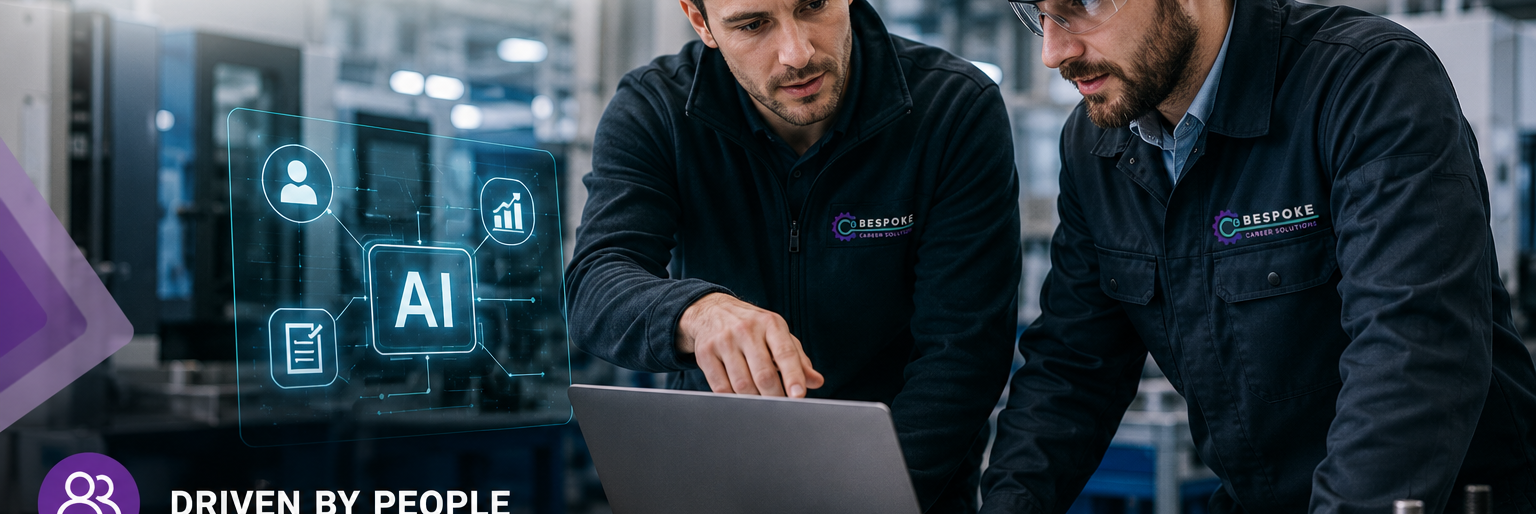
Driven by people, powered by innovation.
Technology can support recruitment, but people must remain at the centre of every important decision.
Where AI can add value in recruitment
Recruitment businesses manage a large amount of information. Job descriptions need to be written, adverts need to be formatted, data must be organised and administrative tasks have to be completed accurately.
AI can help with many of these activities. It can support recruiters by:
- Improving the structure and readability of job adverts. Ensuring all information is provided to candidates applying
- Automating repetitive administrative tasks
- Organising information and recruitment data
- Identifying errors or inconsistencies in documents
- Producing first drafts of internal content
- Supporting reporting and business analysis
- Reducing the time spent on basic, non-customer-facing work
These efficiencies can be valuable. When routine tasks take less time, experienced recruiters can spend more time speaking with candidates, understanding vacancies and building relationships with employers.
The important point is that AI should support the recruiter, not replace the recruiter.
Recruitment requires more than keyword matching
A CV rarely tells the full story.
AI screening systems often rely heavily on job titles, dates, qualifications and keywords. This can make the initial screening process faster, but it can also result in strong candidates being rejected before anyone has spoken to them. If the process is only as good as the prompt someone has written there is a danger of losing quality candidates.
Consider an experienced fabricator who has worked for the same company for 30 years. After being made redundant, they produce a one-line CV that simply says:
“Fabricator – 30 years.”
That CV may not mention MIG welding, TIG welding, reading engineering drawings, operating fabrication machinery, working with different materials or completing quality checks.
The candidate may be highly skilled, reliable and experienced. They may simply have never needed to write a CV before. In fact, this candidate would most likely be the best applicant for the job!
An automated screening system could reject that person because the expected keywords are missing or the prompt does not state to look for these skills. An experienced recruiter would pick up the phone, ask the right questions and uncover the candidate’s real capabilities.
Meanwhile, another applicant may have changed jobs regularly but knows how to write an impressive CV or has used AI to produce one. Their application may contain every relevant keyword, even though their practical experience or reliability may not be as strong.
A polished CV does not always equal a strong candidate. A poor CV does not always equal a poor candidate.
Transferable skills are not always obvious
One of the most important parts of recruitment is recognising transferable skills.
A candidate may not have worked in the exact role being advertised, but they may have experience that can transfer successfully. This is particularly common across engineering, manufacturing, logistics, warehousing and commercial roles.
For example, someone who has maintained heavy industrial machinery may be suitable for a different manufacturing environment, even if the equipment is not identical. A production worker may have the practical ability to move into assembly. A fabricator may have welding experience that is not clearly listed on their CV.
Understanding these possibilities requires more than comparing keywords. It requires knowledge of the job, the working environment and the employer’s expectations.
It also requires a conversation.
Experienced recruiters know which questions to ask. They understand which skills can be transferred, which gaps can be trained and which requirements are genuinely essential.
AI is only as effective as the person using it
AI can be a powerful tool in the hands of someone who understands recruitment.
An experienced recruiter can use technology to work more efficiently because they already understand the processes, procedures and reasons behind each stage of recruitment. They can review AI-generated information, identify mistakes and apply professional judgement.
Problems arise when AI is used as a replacement for knowledge.
An inexperienced recruiter may accept an AI-generated response without understanding whether it is accurate, appropriate or relevant. This can lead to:
- Poorly written or misleading job adverts
- Incorrect advice being given to candidates
- Unsuitable applicants being submitted to employers
- Important questions being missed
- Misunderstandings about pay, shifts or responsibilities
- Candidates being rejected for the wrong reasons
- Clients receiving a generic rather than tailored service
AI can produce confident-sounding information even when it lacks context. Without an experienced person reviewing the output, errors can easily become part of the recruitment process.
Technology does not remove the need for training, experience or sector knowledge.
The growing gap between AI-written CVs and AI screening
Candidates are increasingly using AI to write their CVs. At the same time, more employers and recruitment companies are using AI to screen those CVs.
This creates a strange situation: Robots talking to Robots!
One AI system helps a candidate add the right phrases and keywords. Another AI system assesses whether those phrases and keywords match the vacancy.
The person behind the application can become almost invisible.
A well-written application may move forward because it has been optimised for an automated system. A less polished application from an exceptional candidate may be rejected because it has not.
There is a real risk that recruitment becomes a contest between two pieces of software rather than a process of understanding people. This can be incredibly frustrating for job seekers with relevant skills for a role, especially if the recruiter does not communicate the reasoning behind a rejection.
At Bespoke Career Solutions, we speak to candidates. We do not use AI to make screening decisions.
A conversation allows us to explore experience that may not appear on a CV, understand what the candidate is looking for and explain the vacancy properly. It also gives candidates the opportunity to ask questions and make an informed decision.
Relationships cannot be automated
Recruitment is built on trust.
Clients need confidence that their recruitment partner understands their business, working environment and expectations. Candidates need honest information about the role, the employer and the recruitment process.
These relationships develop through genuine conversations and consistent service.
AI cannot visit a workplace and understand its atmosphere. It cannot fully appreciate why one candidate may suit a particular team while another may not. It cannot recognise every hesitation in someone’s voice or explore the reasons behind a concern.
It also cannot replace the value of a recruiter remembering a previous conversation, understanding a client’s preferences or knowing that a candidate with an unconventional background could be exactly what the business needs.
These are human judgements based on experience and relationships.
Why automated sales messages often fail
AI is also becoming common in recruitment sales and business development. Businesses can now generate and send large numbers of emails with very little effort.
However, volume does not create relationships.
Many automated messages begin with phrases such as:
- “I’m reaching out…”
- “Just circling back…”
- “A quick question…”
- “I wanted to touch base…”
These phrases have become so common that many recipients immediately recognise the message as automated. Rather than considering the service being offered, they mark the email as spam or delete it. Personally, I delete any of these emails before even reading them.
Effective business development requires research, relevance and a clear reason for contacting someone. It involves understanding the organisation, identifying a genuine need and having a meaningful conversation.
At BCS, we do not believe that client relationships should be built through generic, mass-produced sales emails. Employers deserve a personal approach that reflects their individual business and recruitment requirements.
How BCS uses AI responsibly
Bespoke Career Solutions embraces innovation, but we use it carefully.
We use AI and other technology to improve efficiency in areas that do not replace direct candidate or client engagement. It can help us organise information, improve internal processes and reduce the time spent on routine administration.
However, people remain responsible for the parts of recruitment that matter most.
We speak with candidates before making decisions about their suitability. We speak with clients to understand their vacancies, workplace and expectations. We use experience and judgement when considering transferable skills, employment history and individual circumstances.
Technology supports our work. It does not control it.
The future of recruitment should combine people and technology
The future of recruitment is not about choosing between people and AI.
It is about using both in the right way.
AI can make recruitment businesses faster and more efficient. It can remove unnecessary administration and give recruiters better tools. It should create more time for human interaction, not reduce it. We are in the midst of a technological revolution but we must ensure people are still relevant and we can effectively communicate with each other to gain the benefits AI provide.
The strongest recruitment businesses will be those that use technology without losing the personal service that candidates and employers need.
People understand people. People build trust. People make decisions.
Technology can help those people work more effectively.
That is what we mean when we say Bespoke Career Solutions is driven by people, powered by innovation.
Leave a Comment