

 30/07/2026
  6 mins to read
 Written by Richard Bourne, 30th July 2026
Recruiting skilled workers in the manufacturing and engineering sectors can be challenging. Employers often need someone who understands their machinery, products and processes, but candidates with an exact match of experience can be difficult or sometimes impossible to find.
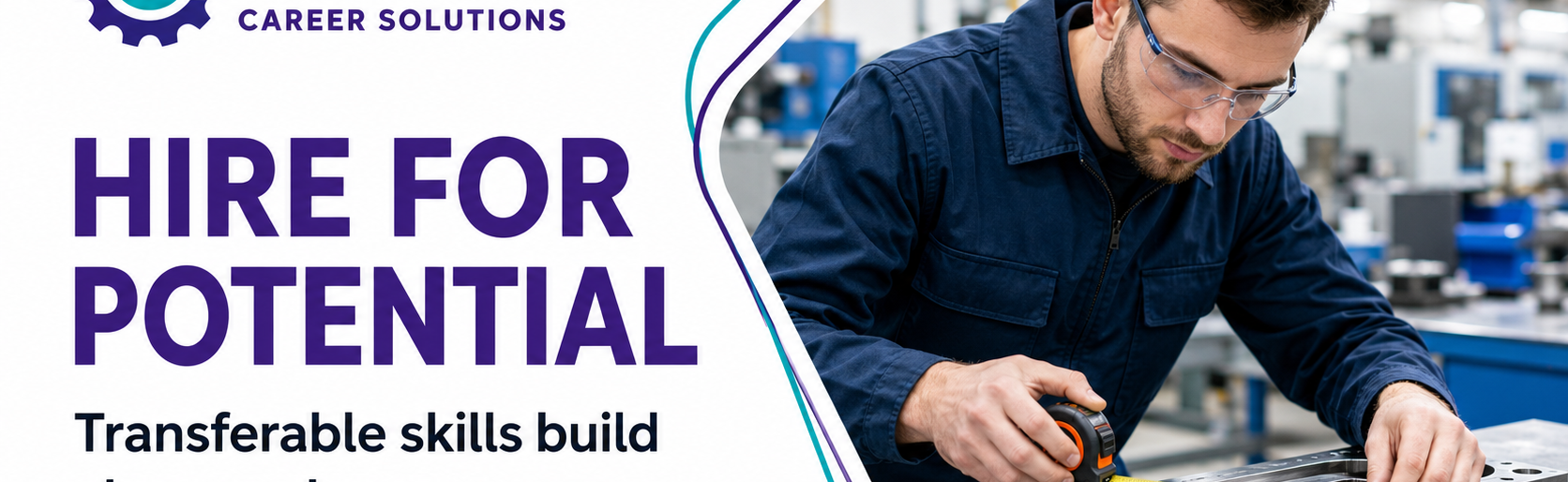
When the ideal candidate is not available, the solution may be to look beyond job titles and focus on transferable skills, practical ability and the potential to learn.
The problem with searching for an exact match
Every manufacturing business works differently. Machinery, materials, production methods and quality standards vary between companies, even when the job titles appear similar.
An employer recruiting a vehicle assembler, fabricator, machine operator or production technician may create a long list of specific requirements. However, expecting candidates to meet every requirement can significantly reduce the available talent pool.
A candidate might not have worked on your exact product, but they may already have the practical foundation needed to become successful in the role.
Look for strong base skills
Many specialist manufacturing and engineering skills can be taught more easily when a candidate already has good practical ability.
Useful transferable skills include:
- Reading a tape measure accurately
- Using hand tools and power tools safely
- Measuring and marking out materials
- Reading basic engineering or assembly drawings
- Drilling, fastening and fitting components
- Working accurately to instructions
- Completing quality checks
- Following health and safety procedures
- Experience within a factory or production environment
These skills provide a strong starting point. With the right training, someone with general assembly or manufacturing experience could progress into vehicle building, UPVC fabrication, mechanical assembly or another skilled production role.
Transferable skills in engineering trades
Engineering trades frequently share practical skills, even when the finished products are different.
For example:
- A mechanical assembler may have the skills needed to move into commercial vehicle assembly.
- A sheet-metal worker could adapt to a fabrication role involving different materials or products.
- A production operative experienced with tools and measurements may be capable of training as a machine operator.
- A vehicle fitter may have transferable skills suitable for trailer building, coachbuilding or chassis assembly.
- A MIG welder without experience in your particular product may still understand welding principles, drawings, preparation and quality standards.
- A maintenance technician from another sector may already understand mechanical fault-finding, hydraulics or pneumatics.
The candidate may require product-specific training, but this is often more realistic than waiting indefinitely for someone whose experience matches every part of the job description.
Upskilling is becoming increasingly important
Manufacturing businesses cannot always recruit ready-made skills from the external market. As experienced workers retire and technology continues to change, employers need to consider how they will develop the next generation of skilled employees.
Upskilling does not always require a lengthy training programme. It could involve:
- Structured workplace training
- Working alongside an experienced employee
- Learning one production process at a time
- Machinery or equipment training
- Developing drawing-reading skills
- Progressing from basic assembly to more complex work
- Supporting employees in gaining recognised qualifications
A clear training plan can turn a capable production worker into a valuable skilled employee. It can also improve retention because candidates are more likely to remain with a business when they can see opportunities to learn and progress.
Separate essential skills from trainable skills
Before advertising a vacancy, employers should divide the requirements into two groups.
The first group should contain genuinely essential skills. These could include a required qualification, welding competency, electrical knowledge or experience operating specialist machinery where safety is critical.
The second group should contain skills that can realistically be taught after the person starts.
This prevents potentially strong candidates from being rejected simply because they have not previously worked with the same product, machinery or manufacturing process.
A more flexible job description could say:
“Previous mechanical assembly, vehicle building, fabrication or general manufacturing experience is preferred. Candidates with strong practical skills, including using hand tools, measuring and marking out, will also be considered.”
This approach attracts candidates with relevant potential while still setting clear expectations.
Assess practical ability, not only the CV
Job titles do not always show what someone can actually do. Two candidates with the same title may have completely different responsibilities, while someone from another trade may possess many of the skills required.
Practical assessments, workplace tours and detailed interviews can help employers understand a candidate’s real ability.
Useful questions include:
- Which hand and power tools have you used?
- Can you read a tape measure accurately?
- Have you worked from drawings or written instructions?
- What materials have you measured, marked or cut?
- Have you assembled components or finished products?
- How did you check the quality of your work?
- What machinery have you operated?
- Can you give an example of learning a new process?
These questions provide more useful evidence than relying entirely on job titles or keyword matches.
The benefits of hiring for potential
Hiring candidates with transferable skills can:
- Increase the number of suitable applicants
- Reduce the time a vacancy remains unfilled
- Bring new experience and ideas into the business
- Create a more flexible, multi-skilled workforce
- Improve employee engagement and retention
- Support succession planning
- Reduce reliance on a limited pool of exact-match candidates
It also gives reliable and motivated people an opportunity to develop a long-term career in manufacturing or engineering.
A balanced approach is essential
Employers should not remove important safety, technical or qualification requirements. Some roles genuinely require proven expertise from the first day, particularly in electrical work, coded welding, maintenance engineering or safety-critical operations.
However, not every part of every role needs to be treated as essential. The key is identifying which skills are critical and which can be developed through training.
How Bespoke Career Solutions can help
At Bespoke Career Solutions, we understand that manufacturing and engineering recruitment involves more than matching job titles.
We take time to understand the work being completed, the tools involved, the working environment and the skills that can realistically be taught. This helps us identify candidates who may not appear to be an exact match on paper but have the practical ability, factory experience and attitude needed to succeed.
If you are struggling to recruit assemblers, fabricators, welders, machine operators, maintenance engineers or production staff, reconsidering transferable skills could help you access a much wider talent pool.
Contact Bespoke Career Solutions to discuss how a more flexible, skills-based recruitment approach could support your business.
Driven by people, powered by innovation.
Leave a Comment