

 23/09/2026
 12 mins to read
Written by Richard Bourne 23rd September 2026
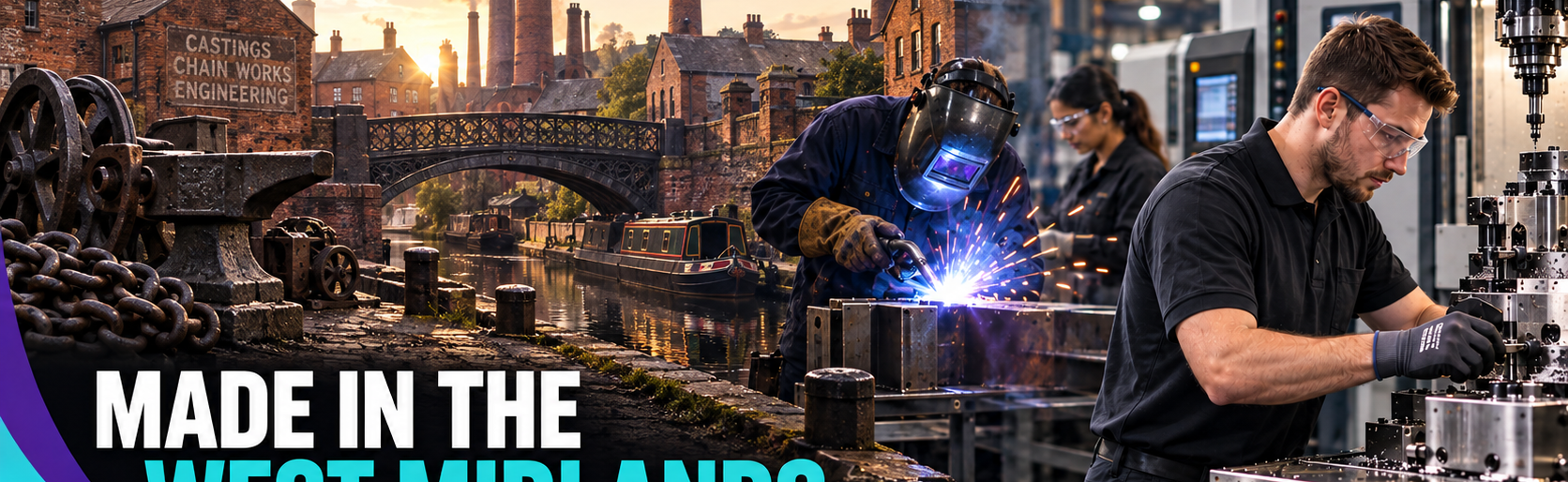
The West Midlands is often described as the heart of UK manufacturing. That description is not based on history alone.
Advanced manufacturing contributes approximately £10.4 billion to the regional economy and supports 11.3% of local jobs, a substantially larger share than the national average. The region also combines established manufacturers, specialist suppliers, skilled tradespeople, universities and internationally recognised research centres.
From traditional metalworking and fabrication to electric vehicles, battery technology, robotics and industrial digitalisation, the West Midlands continues to make things, solve problems and develop the skills British industry needs.
Its industrial past remains important, but its future is the more interesting story.
Why is the West Midlands associated with manufacturing?
Manufacturing is part of the region’s identity because generations of local communities were built around making products.
Birmingham became known for metalworking, tools, jewellery, machinery and thousands of specialist trades. Wolverhampton, Walsall, Dudley and Sandwell developed around iron, steel, foundries, locks, chains, castings and engineering.
Coventry became internationally associated with bicycles, vehicles and automotive engineering. Areas across Warwickshire, Staffordshire, Shropshire and Worcestershire developed their own engineering and manufacturing specialisms.
The Black Country’s importance is recognised through its UNESCO Global Geopark status. Its geology and natural resources helped shape the Industrial Revolution, while the area’s manufacturers helped it become known as the “Workshop of the World”.
That heritage still influences the local labour market.
Many people grow up knowing somebody who works in a factory, engineering business, warehouse or automotive supply company. Practical knowledge is often passed between generations, through apprenticeships, workplace training and time spent alongside experienced employees.
A CNC machinist might have started as an operator before learning setting and programming. A maintenance engineer may have developed from mechanical assembly into hydraulics, pneumatics and electrical fault-finding. A production supervisor may have begun on the shop floor and gradually taken responsibility for people, quality and output.
This accumulated experience is one of the region’s greatest strengths.
Is the West Midlands still a major manufacturing region today?
Yes. The West Midlands remains a major centre for automotive, aerospace, defence, metals, machinery, advanced materials and general engineering.
Official investment information highlights companies including Jaguar Land Rover and Collins Aerospace within the region, together with Aston Martin and JCB in the wider Midlands. It also identifies research and innovation assets such as the Manufacturing Technology Centre, Warwick Manufacturing Group and the UK Battery Industrialisation Centre. Approximately one-third of British-made cars come from West Midlands production lines.
However, the region’s manufacturing strength is not limited to recognisable names.
Behind every major manufacturer is a network of smaller and medium-sized businesses producing components, tooling, fabrications, assemblies, electrical systems, packaging and specialist services.
A finished vehicle or engineered product may involve dozens of local suppliers. One company machines a component, another applies a specialist coating, another manufactures the tooling and another assembles or tests the finished product.
These businesses form the industrial ecosystem that makes the West Midlands so valuable. The region does not simply contain factories. It contains interconnected skills, suppliers and technical knowledge.
Why does the regional supply chain matter?
A strong supply chain allows businesses to find specialist capability closer to home.
For manufacturers, this can shorten lead times, make technical conversations easier and reduce reliance on distant suppliers. It also allows engineers, buyers and production teams to work directly with businesses that understand local industries and customer expectations.
The same principle applies to people.
Someone who has worked for an automotive supplier may have valuable experience of traceability, quality systems, inspection and production targets. A machinist from a precision engineering business may understand tight tolerances and difficult materials. An employee from heavy fabrication may bring strong welding, reading and practical problem-solving skills.
That knowledge moves around the region as people progress through their careers.
This is why local recruitment knowledge matters. A job title rarely tells the whole story. Understanding what nearby companies manufacture, which machinery they use and how their production environments operate can reveal transferable skills that are not obvious from a CV.
How does the West Midlands’ location support manufacturing?
The West Midlands sits at the centre of the country, with access to major road, rail and logistics networks.
This makes it easier for manufacturers to reach customers, suppliers, distribution centres and other parts of their group. It also supports the region’s significant warehousing, transport and logistics sector.
Government investment information describes the region as a key national logistics hub because of its central location and transport infrastructure.
Location alone does not guarantee success, but it gives manufacturers a practical advantage. Raw materials can arrive, finished goods can be distributed and technical teams can reach customer or supplier sites without being located at one geographical extreme of the country.
For employers, the region’s density of towns and industrial areas also creates a large potential workforce. The challenge is that travelling a relatively short distance can still be difficult when shifts begin before public transport starts or finish late at night.
Pay, shift times, transport links and exact location therefore remain important parts of any recruitment plan.
Is West Midlands manufacturing moving into new technology?
The region is not relying on its industrial past. It is using its existing engineering knowledge to compete in newer markets.
Electric vehicles, batteries, clean energy, lightweight materials, automation, robotics and digital manufacturing all create opportunities for businesses that can adapt.
The West Midlands Investment Zone is focused on advanced manufacturing, battery technology, digital innovation and sustainable construction. Current plans are expected to attract more than £5.5 billion of investment over the zone’s lifetime and support the creation of more than 30,000 jobs. These are ambitions rather than guaranteed outcomes, but they show the scale of the opportunity being pursued.
In July 2026, the West Midlands Combined Authority also announced a £50 million electric vehicle employment plan, including match-funded grants intended to help businesses access opportunities within growing electric vehicle supply chains.
A further £50 million research and development initiative includes FORGE for Advanced Manufacturing, led by the University of Warwick. It is intended to support technology-led industrial transformation and stronger supply chains across future mobility and clean energy.
This transition does not make traditional engineering skills irrelevant. It makes them more valuable when combined with modern knowledge.
A battery production facility still needs maintenance engineers, quality technicians, production employees and logistics support. Automated machinery still needs people who can install, operate, set, monitor and repair it. New materials still need to be cut, formed, joined, inspected and tested.
Technology changes the work, but it does not remove the need for capable people.
Which manufacturing and engineering skills are in demand?
Demand varies between sectors and locations, but many employers continue to need practical skills that take time to develop.
CNC setters, operators and programmers are required to produce accurate components consistently. Welders and fabricators turn drawings and raw materials into finished structures. Maintenance engineers keep machinery running and prevent costly breakdowns. Toolmakers, press setters, quality inspectors and production engineers protect output and product standards.
Manufacturing also depends on people whose contribution is sometimes less visible. Production operatives assemble, finish and pack products. Forklift drivers keep materials moving. Warehouse teams control stock and despatch. Supervisors coordinate people and targets. Purchasing, planning, administration and customer service employees help the factory meet its commitments.
The future workforce will need a mixture of practical and digital capability. Employers increasingly value people who can understand a physical process while also using production systems, digital drawings, automated equipment and accurate data.
Skills England projects that priority occupations supporting advanced manufacturing could grow by approximately 47,000 nationally between 2025 and 2035. The report is clear that long-term projections are uncertain, but it still points towards continued demand for engineering and technical skills.
The important point is not that every manufacturing occupation will grow at the same rate. It is that technical skills remain essential to the industries being targeted for future investment.
What is the biggest workforce challenge facing the region?
The West Midlands has deep engineering knowledge, but that knowledge cannot be taken for granted.
Many experienced machinists, welders, toolmakers, maintenance engineers and supervisors are approaching retirement. When they leave, a business can lose much more than one employee.
It may lose knowledge of older machinery, unusual customer specifications, difficult materials and faults that are not covered in a manual. It can also lose the person who informally trains new starters and knows how to keep production moving when something unexpected happens.
At the same time, employers are managing higher labour and operating costs. Some businesses recruit fewer entry-level employees, reduce training or wait for candidates who already possess every required skill.
That creates a difficult cycle. Employers want experienced people, but fewer people are being given the opportunities that create experience.
Manufacturers need to consider succession planning before the knowledge disappears. That could involve documenting processes, cross-training existing employees, recruiting apprentices or bringing in developing workers while experienced colleagues are still available to support them.
What opportunities does the region offer jobseekers?
West Midlands manufacturing offers more than one route into a career.
Some people begin through apprenticeships or technical education. Others enter through production, assembly, warehousing or temporary work and progress by demonstrating reliability and practical ability.
A production operative can become a machine operator. An operator can learn setting. A welder can develop fabrication and drawing-reading skills. A warehouse employee can progress into stock control, planning or supervision.
Not everyone wants the same type of career.
Some people enjoy hands-on work and the satisfaction of seeing what they have made. Others are attracted to fault-finding, design, automation or continuous improvement. Some want predictable working hours, while others prefer shift work because of the additional pay or time it provides outside work.
The variety of West Midlands industry means candidates can explore different environments, from small family engineering firms to major manufacturers and highly automated production sites.
The right opportunity depends on a person’s skills, interests, travelling distance, working-hour preferences and longer-term ambitions.
Why should employers invest in skills as well as recruitment?
Recruitment can bring new skills into a company, but it cannot solve every workforce problem by itself.
An employer may be looking for somebody who can operate machinery, complete changeovers, inspect finished work, drive a forklift and cover basic maintenance. People with that exact combination may be rare.
The business then has a choice. It can pay a rate that attracts the complete skill set, or it can identify the essential starting point and train the remaining skills.
Both approaches can work. The problem comes when the complete skill set is expected at a rate that only reflects part of the role.
Clear pay progression gives employees a reason to learn. Structured training also improves flexibility because more than one person can cover important tasks.
Employers should understand which skills must be present on the first day, which can be learned within a few months and which represent future development.
That distinction can turn a difficult vacancy into a realistic one.
Why does specialist recruitment knowledge matter?
Manufacturing recruitment is rarely as simple as matching a job title to a CV.
Two people described as production operatives may have completely different experience. One may have worked on a fast-moving assembly line. Another may have operated machinery, completed quality checks and carried out minor adjustments.
The same applies to welders, machinists, maintenance engineers and supervisors. The equipment, materials, tolerances, products and working environment all matter.
A specialist recruitment conversation helps uncover those details.
It can establish which abilities are essential, which experience is transferable and where the pay rate should be positioned. It can also identify requirements that are unnecessarily reducing the candidate pool.
How can Bespoke Career Solutions support West Midlands employers?
Bespoke Career Solutions recruits across engineering, manufacturing, logistics and commercial sectors throughout the West Midlands and surrounding areas.
We take time to understand what the business produces, how the role supports the operation and which skills are genuinely required.
Because we speak with local employers and candidates every day, we develop a practical understanding of candidate availability, pay expectations, shift preferences and competitor demand.
Sometimes an employer needs a highly experienced person who can contribute immediately. In other cases, the better solution is somebody with transferable skills and the ability to develop.
Bespoke Career Solutions can support temporary, permanent and temporary-to-permanent recruitment. This gives employers the flexibility to respond to production requirements while still building a dependable long-term workforce.
Our role is not simply to send CVs. It is to help employers make informed recruitment decisions and connect them with people who understand the region’s working culture.
The West Midlands is building on its strengths
The West Midlands remains central to UK manufacturing because it combines industrial heritage with modern capability.
It has skilled people, established supply chains, major manufacturers, specialist smaller businesses, technical universities and nationally important research centres.
There are challenges. Skills must be protected, training needs investment and businesses need to prepare for experienced employees retiring.
There is also genuine opportunity.
New technologies are creating different products, processes and occupations. Investment in advanced manufacturing, electric vehicles, batteries, clean energy and industrial research can create demand throughout the supply chain.
The region will remain a manufacturing heartland if it continues doing what it has always done well, making things, solving practical problems and developing people.
If your business needs support recruiting engineering, manufacturing, logistics or commercial staff, contact Bespoke Career Solutions.
Telephone: 0121 818 5188
Email: jobs@bespokecareersolutions.com
Website: www.bespokecareersolutions.com
Driven by people, powered by innovation.
Leave a Comment